Selling a Naples Home After Hurricane Damage or With an Open Insurance Claim (2026)

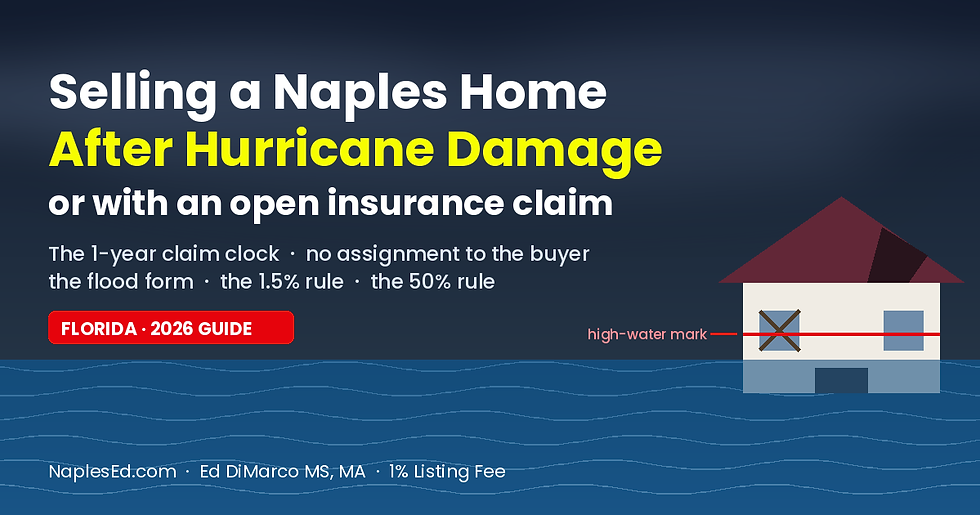
The quick answer: a storm-damaged Naples home sells; an unexplained one does not. File the claim inside Florida’s one-year window, settle it or keep it — you cannot hand it to the buyer — disclose every flood claim and FEMA payment on the state form, and price the house on three numbers: repaired value, cost to repair, and the discount a buyer wants for carrying the uncertainty. In a market that is 55% cash, that discount is smaller than most sellers fear.
Ian put 6 to 9 feet of water through Naples in September 2022; Milton put another 3 to 5 feet along the coast from Bonita Beach to Marco Island in October 2024. Four years on, a meaningful share of the houses on the market in Collier County still carry a repair, a claim, or a county determination from one of those storms — and 2026 has handed their owners an unusual window. As of September 21 the Atlantic had produced zero hurricanes, the first season without one by that date since 1914, while Naples homes were closing at a $575,000 median with 5.4 months of supply and cash paying for 55.2% of Collier closings. This is the guide to selling the house with the storm still in its file.
Key Takeaways
Florida Statutes §627.70132 gives you 1 year from the date of loss to notice a claim and 18 months for a supplemental claim; for a hurricane the date of loss is landfall day, so both Milton windows have closed.
For any residential policy issued on or after January 1, 2023, §627.7152(13) makes an assignment of post-loss benefits void — the open claim stays with you.
Florida’s flood disclosure (§689.302) is due at or before contract and asks two questions buyers read first: did you file a flood-damage insurance claim, and did you receive federal flood assistance.
Under the Florida Realtors/Florida Bar contract, storm damage between contract and closing costing 1.5% of the price or less is the seller’s to fix; above that, the buyer takes the house with a 1.5% credit or walks with the deposit.
Collier County’s 50% rule compares cumulative repair cost with the market value of the structure alone; cross it in a flood zone and the house must be brought to current elevation — the fact that reprices unrepaired homes most.
Data and sources current as of September 24, 2026. Market figures are the NABOR/Southwest Florida MLS August 2026 release for the Overall Naples Market (Collier County excluding Marco Island) unless noted. This article is general information, not legal or insurance advice; your policy, your contract and the county’s determination govern your sale.
Where Naples Stands in September 2026
Two things have changed since the last big storm year, and both favor a seller who is honest about the damage. The weather: the 2026 season has been the quietest in more than a century, so buyers are touring in October without a cone on the television. And the insurance market: Citizens, the state’s insurer of last resort, was down to 266,231 policies in August from 1.41 million at the October 2023 peak, its 2026 multiperil rates fell an average of 8.8%, and the Office of Insurance Regulation’s 30-day average requested homeowners rate change in September was a 4.8% decrease. A buyer who could not get a quote on a storm-repaired house in 2023 can usually get three today. The sales side is steady rather than hot — a $575,000 August median, 99 days to sell, 94.8% of final list price received, active inventory down 20.7% — which is the environment in which a damaged home gets priced through its repairs instead of dumped. The monthly figures live on my Naples housing market statistics page.

Three Ways to Sell a Storm-Damaged Home
Every damaged house in Collier County sells one of three ways. The right one depends on how far along the claim is, whether the house is financeable in its current state, and how much of your equity you are willing to trade for a calendar.
Repair first, then list | List as-is with the claim settled | Sell to a cash buyer | |
|---|---|---|---|
Timeline | Repairs plus a normal listing — typically 3–9 months in total | Normal listing; buyers price the open scope | Written offers in days; closing in 1–4 weeks |
Who carries the claim | You, to conclusion, before listing | You; proceeds retained, unrepaired items credited or priced in | You; the buyer buys the house, not the claim |
Buyer pool | Widest — financed and cash | Financed buyers only if the house is insurable as it sits; otherwise mostly cash | Cash investors and owner-occupants with cash |
Price | Market | Market less the documented scope and a smaller uncertainty discount | Below market — the buyer is paid for speed and risk |
Best when | Claim is paid, contractors are available, and you can carry the house | Claim is paid or nearly so and the remaining work is cosmetic | The 50% rule, an unpaid claim, or your own timeline makes carrying the house the wrong trade |
I run the second and third numbers side by side for sellers before they choose; the method is on my competing cash offers page, and the general case for a listing versus a cash sale is in Cash Offer vs. MLS Listing in Naples.
The Claim Clock: Florida’s Deadlines
Florida shortened its claim windows after the 2022 reforms, and sellers are still caught by them. Under §627.70132 a claim or reopened claim must be noticed to the insurer within 1 year after the date of loss and a supplemental claim within 18 months; for a hurricane, the date of loss is the day it made landfall. Milton made landfall on the evening of October 9, 2024 (0030 UTC on the 10th), so the Milton claim window closed in October 2025 and the supplemental window in April 2026. Damage from either 2024 storm that was never noticed to the carrier is now a repair you pay for, not a claim you sell with.
On the insurer’s side the clocks run under §627.70131: acknowledge the claim within 7 days, begin the investigation within 7 days of your proof of loss, inspect within 30 days, and pay or deny within 60 days of notice — with at most 30 more days if the Office of Insurance Regulation declares carriers unable to keep up after a state of emergency. If a claim is open when you list, the buyer is negotiating against a number that can still change, and that is worth a discount to them; paid before you go to market, it is a line in the disclosure and nothing more.
You Cannot Hand the Claim to the Buyer
Before 2023 a common structure was to sell the damaged house and assign the pending claim to the buyer. That door is closed. For any residential policy issued on or after January 1, 2023, §627.7152(13) says a policyholder may not assign, in whole or in part, any post-loss insurance benefit, and an attempt to do so is void and unenforceable. Almost every Collier County policy has been issued or reissued since that date.
The workable structures are the ones that keep the claim with you. Settle it and sell the repaired house. Settle it, keep the proceeds, and either credit the buyer for the unrepaired scope or price it in. Or sell for cash to a buyer who wants the house at a price that already reflects the work, while you pursue the claim to conclusion on your own. Two mechanics to plan for: a carrier’s check on a mortgaged house is typically payable to you and your servicer, so the servicer’s release procedure is part of your timeline; and any claim proceeds you have already received for work you did not do are a disclosure item, because the buyer’s inspector will find the work undone.
What You Must Disclose
Florida sellers owe buyers disclosure of known facts that materially affect value and are not readily observable — the Johnson v. Davis duty I cover in What Florida Sellers Must Disclose. A storm file is the textbook case: prior water intrusion, a roof replaced under a claim, a mold remediation, an engineer’s letter. Since October 1, 2024 there is also a statutory flood form. Under §689.302 the seller must deliver, at or before the time the sales contract is executed, a disclosure stating that homeowners’ policies do not cover flood, and answering two questions: whether you have filed a claim with an insurance provider relating to flood damage, and whether you have received assistance for flood damage from FEMA or a similar source. The statute defines flooding broadly — tidal overflow, storm-water runoff, sustained standing water — so an Ian surge claim and a summer-rain seepage claim both belong on the form.
Disclosure is also where a damaged house recovers its value. The adjuster’s estimate, the paid invoices, the permits with final inspections, the wind-mitigation report on the new roof and the county’s substantial-damage letter answer every question a buyer would otherwise price as a risk.
Between Contract and Closing: The 1.5% Rule
Sell in season and you will sometimes be under contract when a storm forms. The Florida Realtors/Florida Bar contract handles it in Standard 18(M), Risk of Loss: if the property is damaged after the effective date and the cost of restoration is 1.5% of the purchase price or less, the repair is the seller’s obligation and closing proceeds; if the cost exceeds 1.5%, the buyer may take the property together with a credit of 1.5% of the price, or cancel and receive the deposit back. On the August median that threshold is $8,625 — a few shingles and a lanai screen, not a roof. Standard 18(G), Force Majeure, extends the deadlines including closing for a reasonable time up to 7 days after the event ends, and lets either party cancel if the event prevents performance for more than 30 days past the closing date. The Florida Realtors legal team’s September 2024 note on hurricanes and contract clauses walks through both.
The 50% Rule and Why Buyers Ask About It
The number that reprices a damaged home in a flood zone is not the repair estimate; it is the county’s. Collier County’s substantial improvement and substantial damage rule treats any repair or improvement whose cost equals or exceeds 50 percent of the market value of the structure — the building alone, land excluded — as a trigger to bring the whole house into compliance with current flood-resistant construction standards, including elevating it to the base flood elevation plus one foot. The county uses the Property Appraiser’s improved value, which staff can raise by 20% administratively, or a private state-certified appraisal if you order one. Costs are cumulative: repairs done under different permits and at different times are added together. A house with a $300,000 building value on the tax roll becomes a $360,000 structure with the adjustment, and $180,000 of cumulative work crosses the line.
This cuts both ways. A house that was substantially damaged and never elevated cannot be finished as it stands, and any buyer’s contractor will know it — that is the house a cash investor buys at land value plus. A house whose owner can show the repairs stayed under the threshold, or that used the NFIP policy’s Increased Cost of Compliance benefit — up to $30,000 toward elevation, relocation or demolition after a substantial-damage declaration — has an answer to the question every waterfront buyer in Naples now asks first. Get the county’s letter before you list; it is the single most valuable page in the file.
Roof, Insurance and the Buyer’s Lender
A financed buyer needs a policy to close, so your house is only as salable as it is insurable. Florida law helps a repaired house here. Under §627.7011(5), an insurer may not refuse to write or renew a policy solely because of roof age when the roof is under 15 years old, and for an older roof it must accept an inspection showing at least 5 years of useful life. A roof replaced under a 2022 or 2024 claim is a selling point that belongs in the first line of the remarks, with the permit number. The 4-point and wind-mitigation inspections that carriers rate on are worth ordering yourself before listing; the same reports go to every buyer’s agent. My Florida home insurance guide covers what those reports move on a premium.
Pricing a Storm-Scarred Home in Naples
Buyers price a damaged house from three numbers, so you should too. Start with the repaired value from closed comparables. Subtract the documented cost of the remaining scope — the adjuster’s estimate or two contractor bids, not a guess. Then subtract an uncertainty discount for whatever is undocumented: an open claim, an unpermitted repair, a missing county letter. The first two are arithmetic. The third is where a seller earns money or gives it away, because every document you produce shrinks it; a damaged house with a complete file sells inside the market’s 94.8%-of-list band, and one without a file sells well outside it.
Cash changes the math. With 55.2% of Collier County closings paid in cash in August (Florida Realtors SunStats, county figure including Marco Island), a house that a lender will not touch still has a buyer pool — but a narrower one, and it prices accordingly. Where the house is insurable as it sits, list it at my 1% listing fee and let financed and cash buyers compete on the MLS; where it is not, or the timeline matters more than the last dollar, I put it in front of vetted cash buyers and show you the cash net beside the listing net before you decide. Real estate commissions are not set by law and are fully negotiable. Figures shown are illustrative examples only, not a quote or guarantee.
Ed’s Take: What I’m Seeing in the Field
Every owner who took water in 2022 or 2024 has heard the same two pieces of advice: fix everything before you list, or take the first cash offer and be done. Both are usually wrong. The houses that lose money are the ones sold with a story instead of a file — a roof “handled by insurance” with no permit, a claim “still working its way through,” a county letter nobody requested. The houses that hold their number have a folder on the kitchen counter: estimate, invoices, final inspections, the substantial-damage letter, the flood form already filled in. This September is the best selling weather Naples has had in years — no storm on the map, insurers cutting rates, inventory down a fifth — and the sellers using it are the ones who spent August on paperwork rather than paint. My prediction: by next hurricane season the gap between a documented storm-repaired home and an undocumented one will be wider than the gap between a repaired home and an untouched one. The file is the product.
Final Thoughts
Hurricane damage is a known scope with a known set of rules — a one-year claim clock, no assignment to the buyer, a flood form at contract, a 1.5% line in the contract, a 50% line at the county. Work through them in that order and the storm becomes a paragraph in the disclosure. Skip them and it becomes the reason the buyer’s inspector renegotiates in week three. The choice, as usual, is the seller’s.
Frequently Asked Questions About Selling a Home With Storm Damage or an Open Claim
Can I sell my house in Florida with an open insurance claim?
Yes, but the claim stays with you. For policies issued on or after January 1, 2023, §627.7152(13) makes an assignment of post-loss benefits to the buyer void. You settle the claim before closing, keep the proceeds and credit the buyer for unrepaired work, or sell for cash at a price that reflects the remaining scope while you finish the claim yourself.
How long do I have to file a hurricane claim in Florida?
One year from the date of loss for a new or reopened claim and 18 months for a supplemental claim (§627.70132); for a hurricane the date of loss is landfall day. The insurer then has 60 days from notice to pay or deny (§627.70131), extendable by at most 30 days after a declared emergency.
Do I have to tell buyers about a past flood claim?
Yes. Since October 1, 2024, §689.302 requires a flood disclosure at or before contract stating whether you filed an insurance claim for flood damage and whether you received federal flood assistance — on top of Florida’s general duty to disclose known material defects that are not readily observable.
What happens if a hurricane hits after I’m under contract?
Under Standard 18(M) of the Florida Realtors/Florida Bar contract, restoration costing 1.5% of the purchase price or less is the seller’s obligation and closing proceeds; above 1.5% the buyer takes the property with a 1.5% credit or cancels for a deposit refund. Force majeure extends deadlines up to 7 days after the event and allows cancellation past 30 days.
What is the 50% rule and does it affect my sale?
In Collier County, cumulative repairs or improvements costing 50% or more of the market value of the structure — building only, per the Property Appraiser’s value plus an optional 20% adjustment, or a private appraisal — require the home to meet current flood-construction standards, including elevation to base flood elevation plus one foot. A county letter showing your repairs stayed under the threshold protects your price; a house that crossed it and was never elevated sells to a narrower, mostly cash, pool.
Article By: Ed DiMarco MS, MA
Ed DiMarco is a Naples, Florida real estate agent with Realty Hub — 14 years as a Gulf Coast, Florida real estate agent, $54 million in closed transaction volume between March 2025 and September 2026, 36 closed sales on Zillow with a 5.0★ rating, and quotes in Kiplinger, USA Today, Bisnow and Yahoo News. He lists Naples, Bonita Springs, Estero and Marco Island homes for a 1% listing fee with full service and represents buyers with part of the commission credited back at closing. MS in Business Management and MA in Communication, University of South Florida. Investor since 2004.


