Appraisal Gaps, Explained: What Happens When the Number Comes In Low — and Your Five Moves


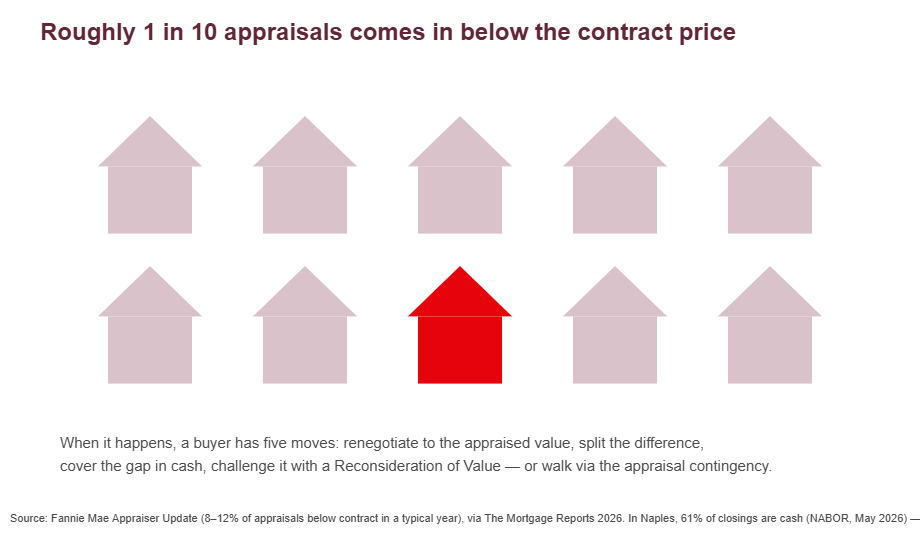
The quick answer: An appraisal gap is the difference between your contract price and the appraiser’s lower opinion of value — and roughly one in ten appraisals comes in below contract in a typical year. When it happens, the buyer has five moves: renegotiate, split the difference, cover the gap in cash, challenge the appraisal, or walk away under an appraisal contingency.
Key Takeaways
Per Fannie Mae’s Appraiser Update, roughly 8–12% of appraisals come in below the contract price in a typical year — common enough to plan for, rare enough to surprise people.
The lender lends against the lower of price or appraised value — a gap doesn’t kill the loan, it shrinks it, and someone has to fill the hole.
Five responses exist: renegotiate to appraised value, split the difference, pay the gap in cash, file a Reconsideration of Value with better comps, or exit via the appraisal contingency.
Appraisers work mainly from closed comps of the last 3–6 months — in a fast-moving or thin market, the data lags the market, which is where gaps are born.
Naples wrinkle: with 61% of closings all-cash, most local deals never involve a lender appraisal — which changes seller epectations and financed buyers’ tactics.
Reviewed and current as of August 2026. The appraisal mechanics described here are stable industry practice; the below-contract frequency is Fannie Mae’s published range and varies with market conditions.
No phrase deflates a deal faster than “the appraisal came in low.” Buyers hear a lost house, sellers hear an insult, and both are usually wrong. An appraisal gap is a financing problem with five known solutions — and in Naples, where most buyers skip appraisals entirely, understanding those solutions is a genuine competitive edge for everyone still using a mortgage. Here is how the number gets made, and what to do when it comes in short.
How the Number Gets Made
A lender’s appraiser is not guessing what the home is “worth to you.” For residential property they lean almost entirely on the sales comparison approach: closed sales of similar homes from roughly the last 3–6 months, adjusted for size, condition, location, and features. That method is honest and slow — it prices today’s contract with yesterday’s data. In a rising or thin market, comps lag the deals being written, and the gap between what a motivated buyer will pay and what the file can support is eactly where low appraisals come from. Condition and location still move the number (roof age, renovations, busy roads), but the comp set decides most of it.
The Five Moves When It Comes In Low
Move | How it works | Best when |
|---|---|---|
Renegotiate | Seller reduces price to appraised value | Slow market, few backup buyers |
Split the difference | Price cut + buyer cash meet in the middle | Small gaps; both sides motivated |
Cover the gap | Buyer brings extra cash to closing | Competitive offers; buyer has reserves |
Reconsideration of Value | Formal challenge with better comps via the lender | Appraiser missed relevant sales |
Walk away | Appraisal contingency returns the deposit | Gap too large; numbers no longer work |
The order matters. Renegotiation is the default in a balanced market — a seller facing a documented low appraisal knows the net financed buyer will likely meet the same number. The Reconsideration of Value is underused: it is free, it works when there are genuinely better comps, and buyers’ agents who write a tight comp memo win a meaningful share of them. Gap coverage and contingencies are not opposites — a well-written offer can cap coverage (“up to $15,000”) with the contingency protecting anything beyond the cap.
The Naples Wrinkle: Cash Doesn’t Appraise
With 61% of Naples closings all-cash, the appraisal is absent from most local deals — cash buyers may order one for information, but nothing hinges on it. Two consequences follow. Sellers here are less trained by appraisal discipline, so financed buyers’ low-appraisal renegotiations can meet more resistance than the data justifies. And a financed buyer competing against cash should decide their appraisal-gap posture before offering: a capped gap-coverage clause reads almost as strong as cash while preserving the walk-away right. That is offer engineering, and it is precisely the kind of work buyer representation that credits compensation back at closing should be doing for you. Sellers who would rather skip the appraisal lottery entirely can weigh a direct cash offer against the financed market.
Real estate commissions are not set by law and are fully negotiable. Figures shown are illustrative examples only, not a quote or guarantee.
Sellers: Pricing Against the Appraisal
A seller’s best appraisal-gap strategy happens before listing: price where the comps can carry the file. A contract $40K above anything closed nearby is a renegotiation scheduled for week four. When the offer comes in hot from a financed buyer, ask how they handle a low appraisal — gap coverage in writing separates strong offers from optimistic ones. And on appraisal day, show up on paper: a one-page list of improvements with dates and costs, handed to the appraiser, is the cheapest value defense that eists. This is standard procedure in every 1% listing I run.
Ed’s Take: What I’m Seeing in the Field
Appraisal panic is almost always information panic — nobody in the deal has seen the comp set, so everybody assumes the worst. In practice the gap resolves along predictable lines: in a market like today’s, with 108-day timelines and sellers short on backup offers, the seller usually moves most of the way, because the appraisal follows the house to the net financed buyer. What kills deals is pride and deadline pressure, not the number itself. Naples adds its own distortion — cash-heavy segments where sellers haven’t faced an appraiser in years — and that is where a documented, unemotional renegotiation earns its keep. My prediction: as lenders lean further into automated valuations and hybrid appraisals, gaps get rarer on cookie-cutter product and gnarlier on the unique homes — waterfront, acreage, heavy renovation — which is exactly where Naples lives. Comp memos are about to matter more, not less.
Final Thoughts
An appraisal gap is a solvable, scheduled, well-mapped event — one in ten deals, five known eits. Buyers: decide your gap posture before you offer, and never waive the contingency casually in a market where you don’t have to. Sellers: price to the comps, document your improvements, and treat a low appraisal as a negotiation you were always going to have. The number is not a verdict; it is the opening position of the last negotiation in the deal.
Frequently Asked Questions
How often do appraisals come in below the contract price?
Roughly 8–12% of the time in a typical year, per Fannie Mae’s Appraiser Update — about one financed deal in ten. The rate rises when prices move quickly and comps lag.
Who pays for the appraisal, and what does it cost?
The buyer, ordered through the lender — typically around $600 in Southwest Florida, due whether or not the deal closes.
What is appraisal gap coverage?
A contract clause where the buyer commits to covering some or all of a shortfall in cash — often capped (“up to $15,000”). It strengthens an offer against cash competition while the appraisal contingency still protects beyond the cap.
Can a low appraisal be challenged?
Yes — a Reconsideration of Value, filed through the lender with specific better comps and factual corrections. It succeeds often enough to always be worth evaluating, and it costs nothing but a well-argued memo.
Do cash buyers need an appraisal?
No — no lender, no required appraisal, which is why 61% of Naples closings never involve one. Cash buyers sometimes order an informational appraisal for peace of mind, but nothing in the deal depends on it.
Ed DiMarco is a Naples, Florida Realtor with Realty Hub offering full-service listings at a 1% fee and buyer representation that credits leftover buyer-agent compensation back at closing. He writes data-first guides to the Southwest Florida market at NaplesEd.com.
References
The Mortgage Reports — How to deal with an appraisal gap (Fannie Mae Appraiser Update figures): themortgagereports.com
Opendoor — Appraisal came in low: buyer and seller options: opendoor.com
Progressive — How appraisers develop their opinion of home value: progressive.com
NABOR May 2026 Market Report — all-cash closing share (primary PDF): marketstats.naplesarea.com